Category Archives: Nature

Hair Ice, Spring Coming

We had a false spring at the start of February, followed by a cold snap last week that gave us a couple good hair ice (frost flower) mornings.

The one yesterday is likely the last one of the season, so I took half an hour off work to tromp around in the cold woods.

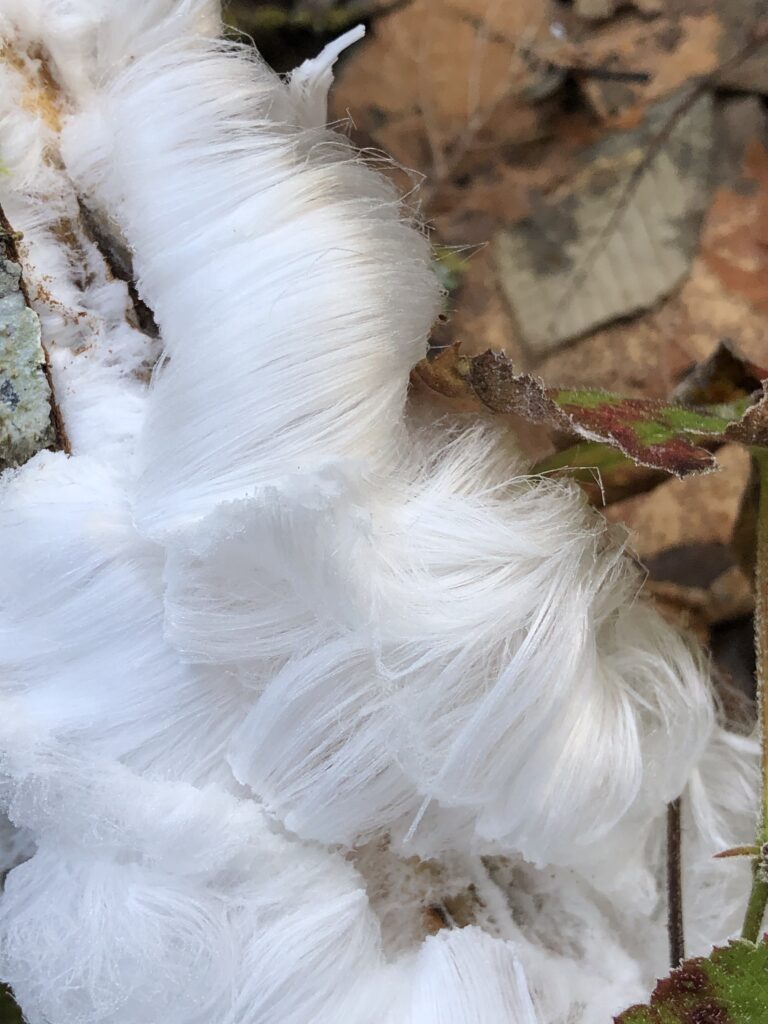
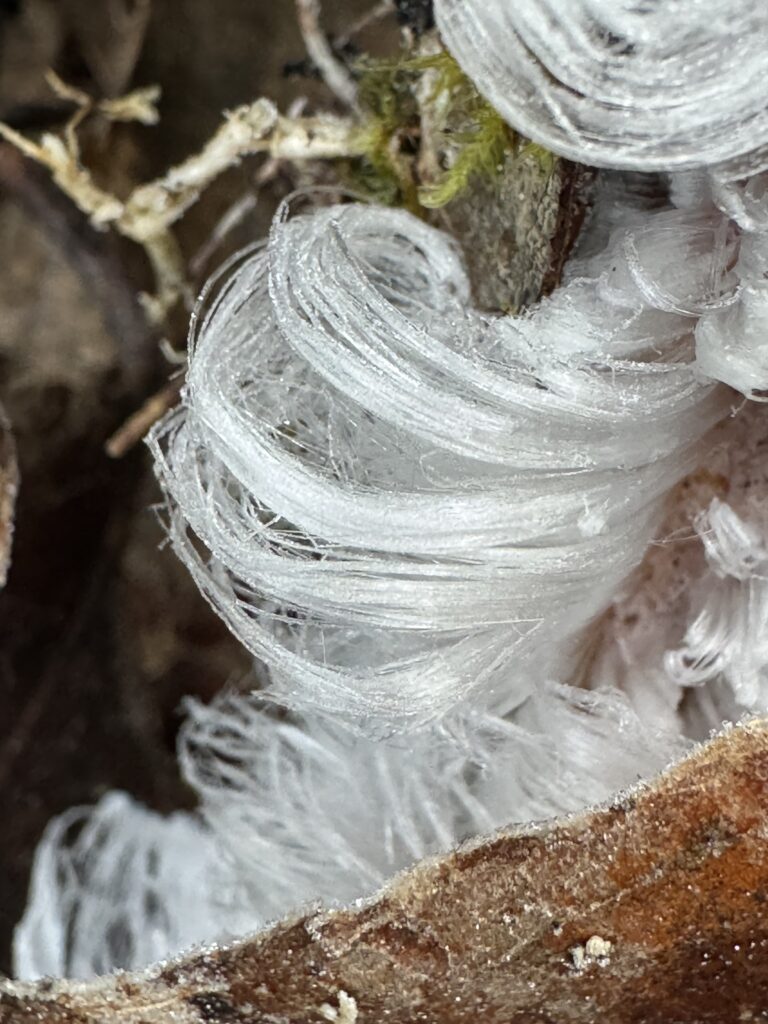
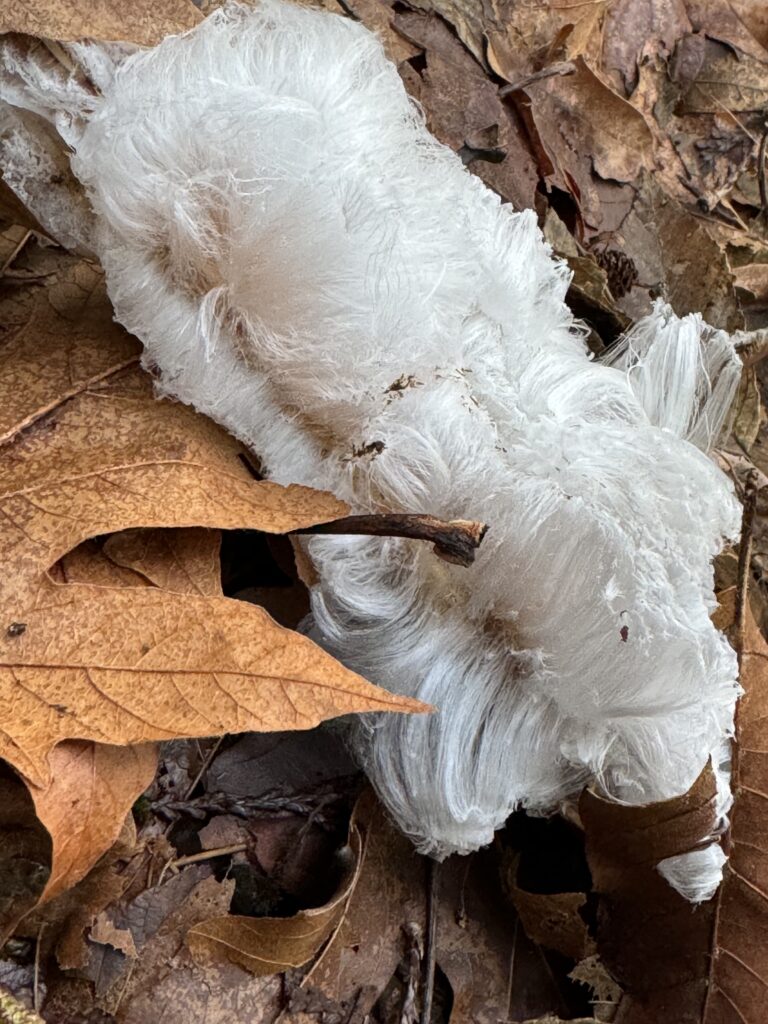
A stick on the ground has a complex formation of frost growing out of it. It looks like short, wavy locks of pure white hair

This is a globally rare phenomenon, but I am lucky enough to live in an area where it usually happens at least several times each winter.

This has been an especially good winter for hair ice!

A closeup of the hairlike clumps of frost. There is a longer lower layer, and shorter upward-curving layers "growing" from higher on the curve of the stick

To “grow,” hair ice needs temperatures just below freezing (~28-32F seems to be the happy range) for at least a few hours. It needs thoroughly sodden dead sticks that have been colonized by fungus Exidiopsis effusa.

Around here, they’re alder sticks. Fortunately they are a common native.

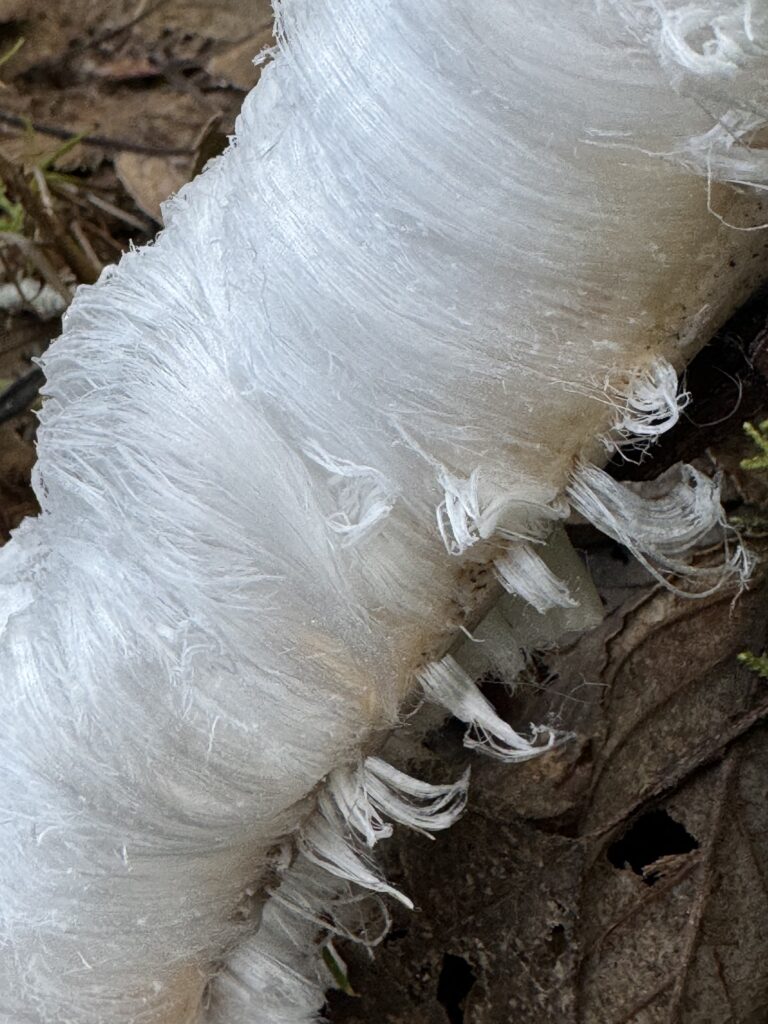
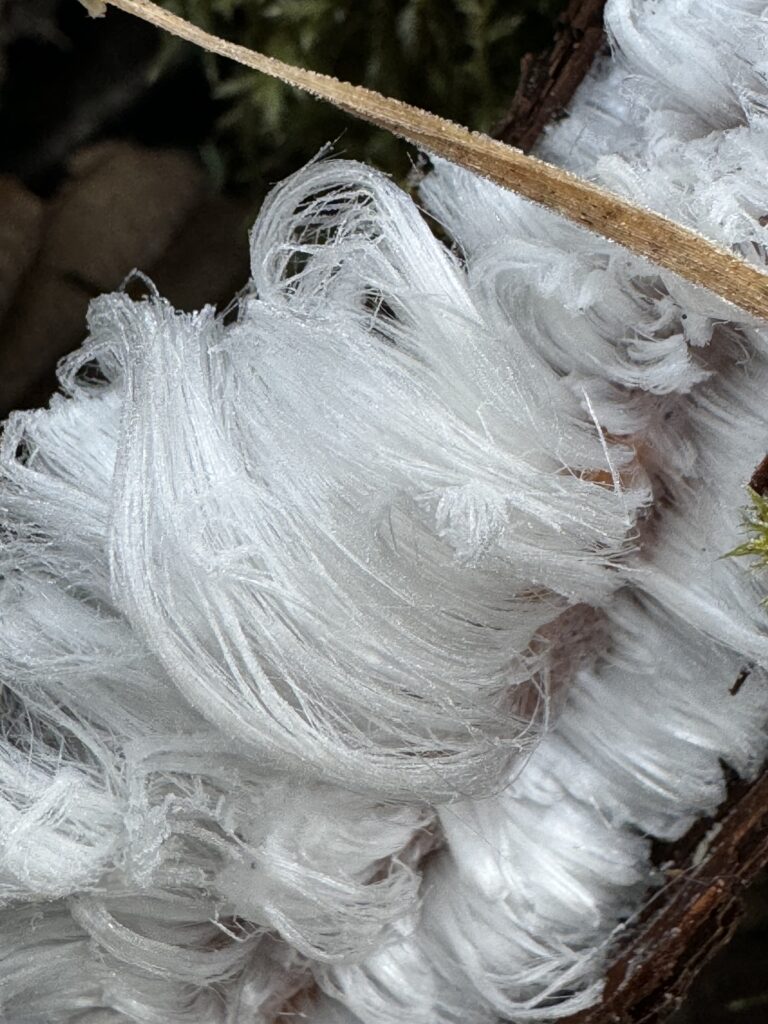
Extreme closeup of hairlike frost formations. It clearly "grows" from the stick as from a scalp. Some of the strands are long and nearly straight, forming clumps. Others form little curls.

Around here, the sweet spot seems to be dead sticks that have been down a couple years, but they will only bear good frost flowers / hair ice for one season.

I have set aside “good” sticks before, and the next season there might be a few paltry formations, but short and disappointing.

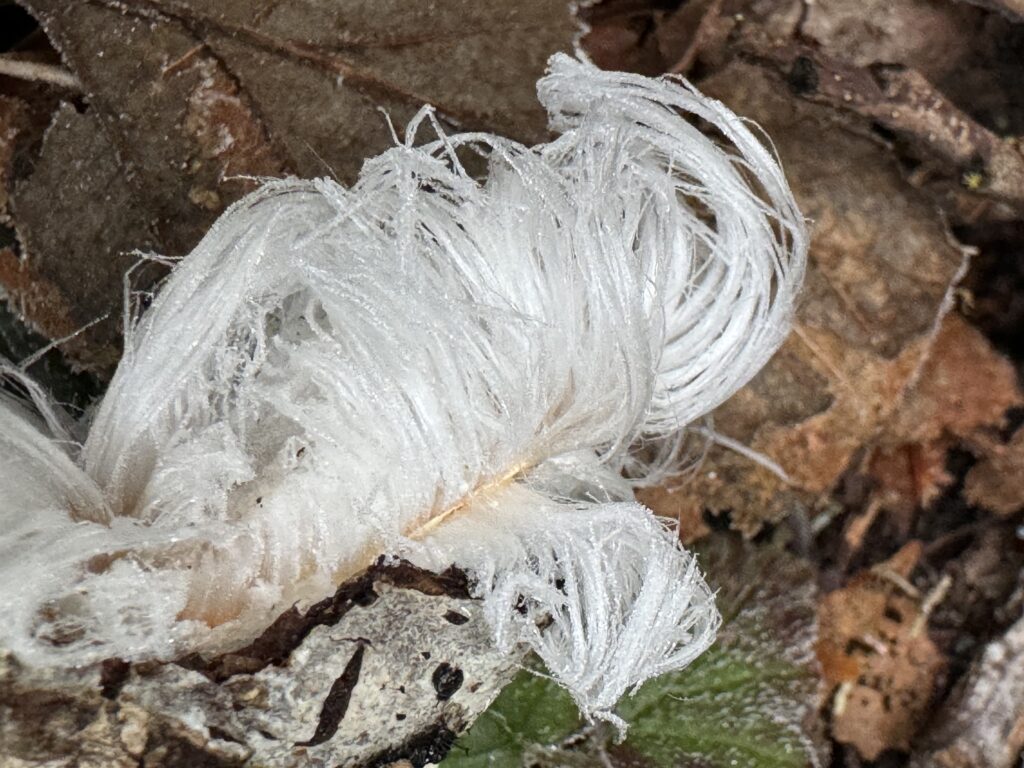
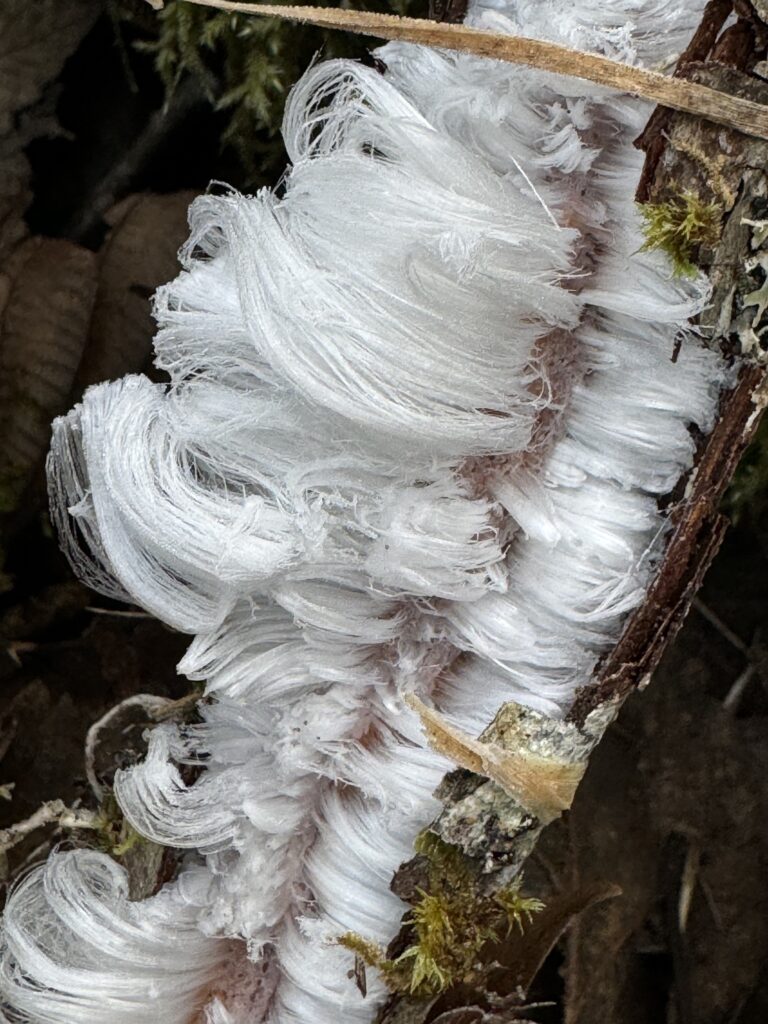
A gracious curving wave of hairlike frost grows from a stick, with bark and moss providing interest. There is a nice tight little wave above the broad sweep

Even within one season, especially spectacular sticks at the beginning may be subsiding by the end.

This is a very nice formation, but —

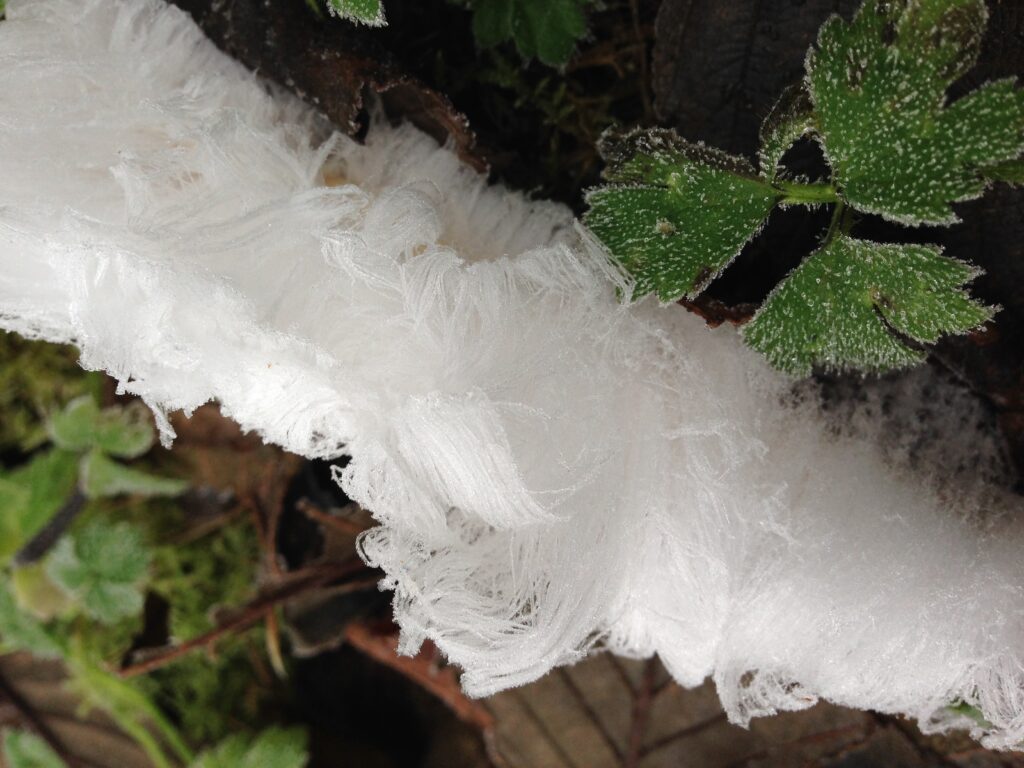
Curving formation of frost with grass and blackberry leaves

The one from a month ago was much more spectacular.

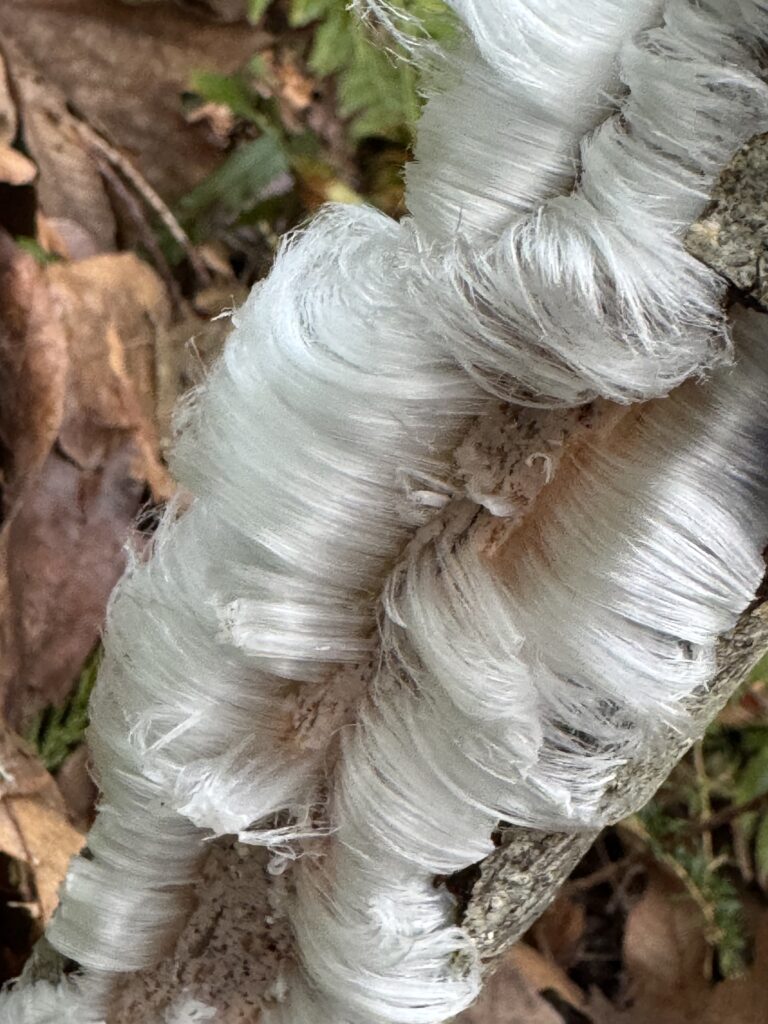
A long curly expanse of hair-like frost grows out of a stick, interacting with grass and blackberry leaves

Note that this is a longer shot, that includes another six inches of stick above the newer close-up.

That is partly because this earlier formation was just bigger and more impressive; the newer formation is still lovely, but smaller.

A stick slants across the middle frame, with a curling wave of hair ice growing out of the bottom

It makes for a wonderful theme-and-variation throughout the season, with different temperature ranges growing frost out on different sticks to different extents.

Documenting the beauties of hair ice is one of my winter joys.

A stick grows a dramatic wave of hair ice, with the bark constraining the growth and a little twig-stub poking out of the middle of the formation

Thanks for joining me for this jaunt in the woods!

If you’re hungry for more, I have lots of posts of hair ice/frost flowers. Click on the topics above the header to easily find other posts.

Hair Ice and New Year’s

Happy New Year!

Over the last few mornings, we had a lovely little stretch where conditions were suitable for hair ice (frost flowers) to grow.

That does not mean “lovely” for tromping around in the woods, since it has to be slightly below freezing, but these beauties are worth some discomfort!

A stick "grows" perfect white locks of ice that look like a wig

Those of you who have known me for a while know that I prefer “frost flowers” as the term for these… but I’m reluctantly caving in to the reality that “hair ice” is both more frequently used, and more apt for most of the formations.

The same stick, zoomed out some so that the whole stick shows. One stick in a large heap of sticks and leaves is growing snowy curving locks of "hair"

The thaw is on now, so these pictures are New Year’s Eve hair ice, not New Year’s Day hair ice.

A hair ice formation cuts diagonally across the central frame. The stick is completely hidden, so it looks like gently curling white hair with a central part

Around here (south Puget Sound), hair ice “grows” on 2-3 year dead alder twigs and branches. The locks of the last couple days have been especially long, probably because the temperature has lingered just below freezing for hours.

When there is more of a cold snap, the formations can be cut short.

Short and long waves of snowy white hair ice

Often, larger sticks mean longer hair ice locks, but under optimal conditions even a skinny stick can grow impressive formations.

In this example, a slim stick 1-2 cm diameter grows hair ice 10-fold the length. Probably most of the moisture has extruded!

A stick covered with snowy white hair ice locks angles across a backdrop of moss and dead leaves. The stick is completely obscured by the snowy white hair-like formations.

I admit that I enjoy the especially lush growths, where thousands of ice hairs form a graceful formation.

However, it’s easier to see what’s going on in the sparser formations.

A large stick with some moss supports a narrow band of hair ice, each filament visible against the dark backdrop

In an acre of alder woods, I might see 5-10 sticks with really nice hair ice, and the same number again that are small or poorly formed.

A hair ice formation looks closer to cotton fluff than hair. It is growing from a fat old stick with lightly frosted blackberry leaves and dead grass clustered around. An alder cone cluster is visible just next to the formation.

We have been amazingly lucky in that both homes Rob and I have had together (Port Angeles and Olympia WA) have supported hair ice growth.

Alder groves+maritime climate with occasional frost=hair ice!

Glossy white locks grow from a narrow stick angled across a sword fern leaf

I found my first “home” hair ice 10 years ago, 12/30/2015, at the house we lived in at Port Angeles. 

Here is one of the handful of formations I found that day.

Glossy white locks grow from a narrow stick angled across a sword fern leaf

The first hair ice I ever saw was actually on a hike on the Olympic Peninsula.

The first hair ice I ever saw was actually on a hike on the Olympic Peninsula the previous winter, 1/3/2015.

It was at a camp site by the Elwha River.

I had never seen anything like them, bits of cotton fluff scattered around.

This is still one of my favorite formations!

The first hair ice I ever saw was actually on a hike on the Olympic Peninsula.

Because they are only out when it’s unpleasantly cold, your odds of running across them randomly like this are not good.

However, now that I know what to look for, I am out at dawn on every frosty morning.

I feel very lucky to have these to share!

May the new year hold many such little joys for you!

May there be previous moments and unexpected beauty.

Best wishes for the New Year!

A large cottony cluster of hair ice grows from near the top of a stick. It looks like lightly teased curly white hair.

First Frost Flowers of the Season!

We had our first hard frost last night — much later than usual! — and with it, the first frost flowers/hair ice of the season.

A stick "grows" a large cluster of hair-like ice crystals, so it looks like it is wrapped in lightly curled/cow-licked white locks

Hair ice is more apt for most of the formations — especially because the frost effectively “grows” from the stick — but I admit I like the aesthetics of “frost flowers” better.

Closer image of frost that looks like snowy locks

This rare phenomenon usually occurs at least a few times each winter in our area.

It requires: sodden twigs that have been colonized by a certain fungus and temperatures that go from above freezing the previous day to just a couple/few degrees below to “grow” the crystals.

A twig with a split in the bark "grows" silky-looking white locks all along the split

There weren’t many frost flowers this time — it was only just barely cold enough, so only the most exposed candidate sticks grew the formations. 

It is lovely to have any, though!

A floret of frost grows from the end of a stick

If you want to learn more, I did a more detailed blog post a couple years ago:

Garden Update

It has been a busy spring: work, life, and a sick kitty conspired to stretch us thin. Things are finally settling down, in time for us to enjoy the lead-up to summer.

The swallowtails have arrived, just in time for the Dame’s Rocket. This is a lovely plant, but invasive in some areas — check before you grow!

A bunch of other things are starting to bloom or just hitting their stride.

The Harsh Paintbrush has been going for a couple weeks now. I grew these from seed two years ago, and am very pleased that they are solidly perennial.

The slugs tend to munch on them when they’re starting to res-route; the copper around the pots eliminates that problem. I’ll be trying to plant some out this year — we’ll see whether I can keep them safe in the spring in the ground!

I also started some baby paintbrushes from some of the plants that bloomed last year. It’s gratifying to have their propagation down — maybe not to nursery standards, but quite solidly enough for home use.

I scarify the seeds in a ziplock back with some damp coconut coir for 6 weeks, then I sprinkle them in a 4″ pot filled with a coir/perlite/vermiculite mixture with a little vermiculite over. They sprouted in just a few days under grow lights in the basement.

About a month on, I use a fork to pull out chunks and stick them in 2″ pots. Then I sprinkle some native yarrow seeds over: these will act as the host plant, since paintbrushes are semi-parasitic. Yarrow sprout fast enough that they catch up nicely, and then they can grow up together.

Unfortunately not everything was so successful.

The native penstemon were getting off to an amazing start after the same scarification and planting regiment as the paintbrushes… but they had a mold attack very early on, and it pretty much destroyed them. I might get one.

Lesson here: plant them more thinly, and maybe don’t use vermiculite over them; I feel like the vermiculite made it worse.

The planting notes for this species do mention that they are susceptible to damping off… so I will be much more careful next time!

One other note on damping off:

I was a good girl and bleached all my pots this year, and it made a big difference (penstemon aside). The only things I had any problems with were my first batch of chocolate cosmos (note to self, they do *not* like being wet — keep them on the dry side until they hit their stride), and the penstemon.

So, lots of success and a few failures this spring.

More notes later! I will resist putting everything in this one catch-up post 😉

Frost Flowers!

We finally had the conditions for good frost flowers Thursday night/Friday morning.

Pure white strands that look like hair "grow" in locks from a stick lying on a bed of moss

Under exactly the right conditions (temperature, moisture, dead sticks ravaged by the correct fungi), dead sticks “grow” strands of ice that form formations that look like locks of hair… or, sometimes, like flowers!

Aesthetically I like the latter term better.

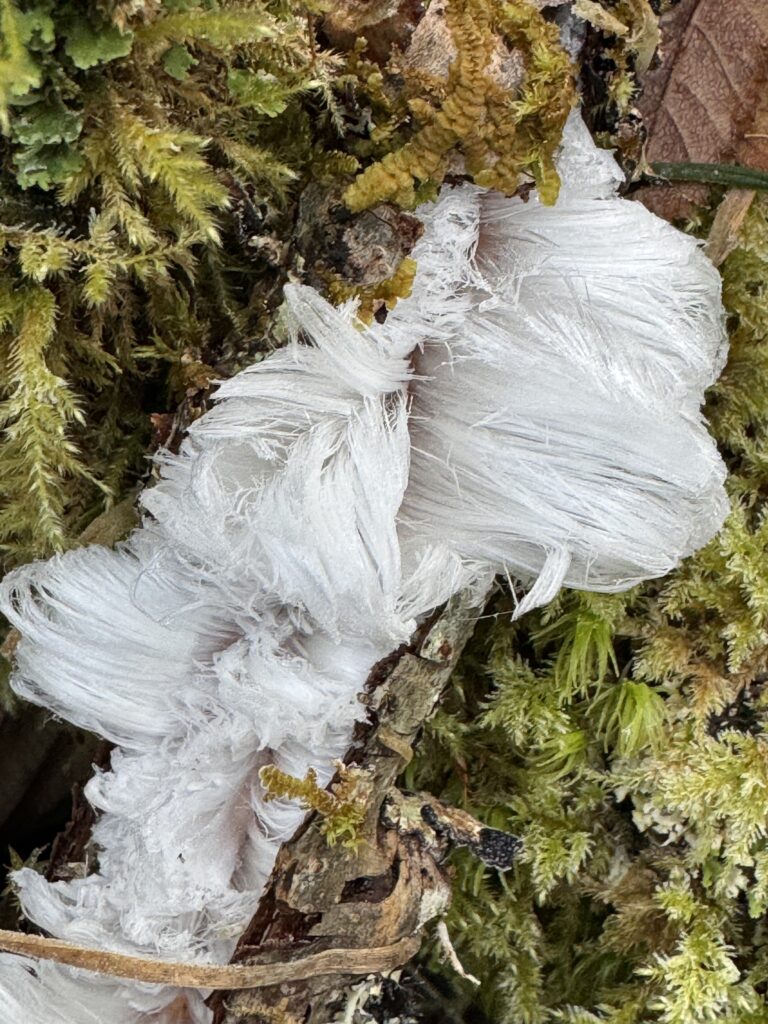
Closeup of strands of ice that look exactly like a big clump of white hair. Moss is visible in the lower right.

We are lucky enough to live in an area that usually has the correct conditions a few times each winter.

However, this was the first really good batch of frost flowers of the season!

Closeup of strands of ice that look exactly like a big clump of white hair. Moss is visible in the lower left. The strands are clearly visible against sticks and leaves.

The temperature range has been correct (we’ve been having an unusually chilly span, where it is below freezing each night, above during the day). 

This would normally be perfect, but the humidity has been too high!

The result is gloppy frost flowers, where secondary frost messes up the formation.

Strands of frost have grown on a stick, and then been overlaid by a secondary layer of frost, hiding most of the detail of the original frost

So it was a joy to go out Friday morning and find lots of really well-grown frost flowers!

This means that the sticks were well sodden, and the temperature range was correct for many hours.

A puff of white "hairs" of frost, forming a flower configuration. The frost has grown from the end of a stick, resulting in a common "growth" point. The strands form a dense fluff of frost, which shows up as bright white against a backdrop of brown and green

From a distance, they are eye-catching but not beautiful. They just look out of place: clumps of pure white in a landscape of brown and green.

In our area (South Puget Sound), they are strongly associated with alders.

So check your alder groves on a cold morning!

A pure puff of white looks out of place in the middle of the frame. The rest of the frame is an unkempt woods understory scene: dead leaves, broken sticks, moss, and a tangle of trailing blackberry vines.

I hope you have enjoyed this foray!

I’ll close out with one that shows off especially nice distinct locks. Because it is a small twig, the growth was not so luxuriant as to hide the structure.

A twig has a serious of pure white cowlicks growing out of it. It has a distinct center part that shows pale dead wood peeking through

Ginkgo Drop Day(s)

Ginkgos are wonderful and ancient trees that are unusual in a number of ways.

One of their unusual features is Ginko Drop “Day”: they drop their leaves in a very short period, a day or two or three, rather than over the course of weeks like most deciduous trees.

These pictures were taken November 9th, when the leaf drop began in earnest, and November 13th, when it was pretty much done. The tree lost 90% of its leaves in about 3 days.

I’ll call “leaf drop” day November 11th this year. It was similar in 2023.

Tracked over the years, it makes a good indicator of local weather patterns.

Angelica

The spring has flown! Work deadlines have kept me tied up through the glories of mid-spring. Most of those glories have been wonderful, but familiar.
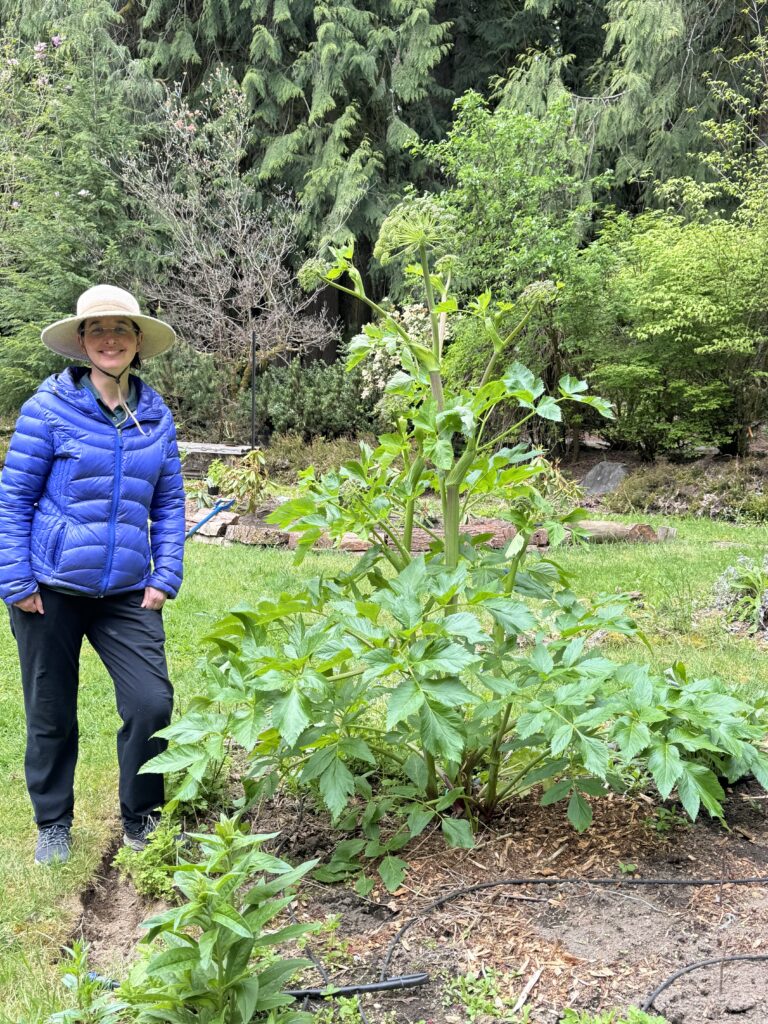
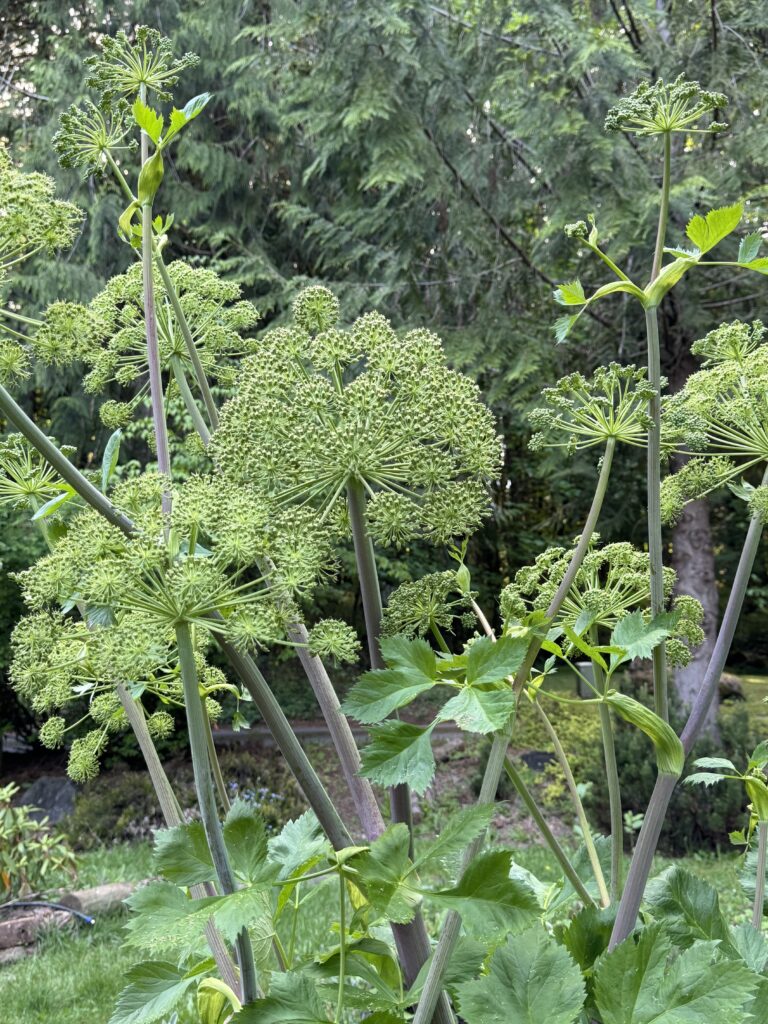
A major exception has been the Angelica!

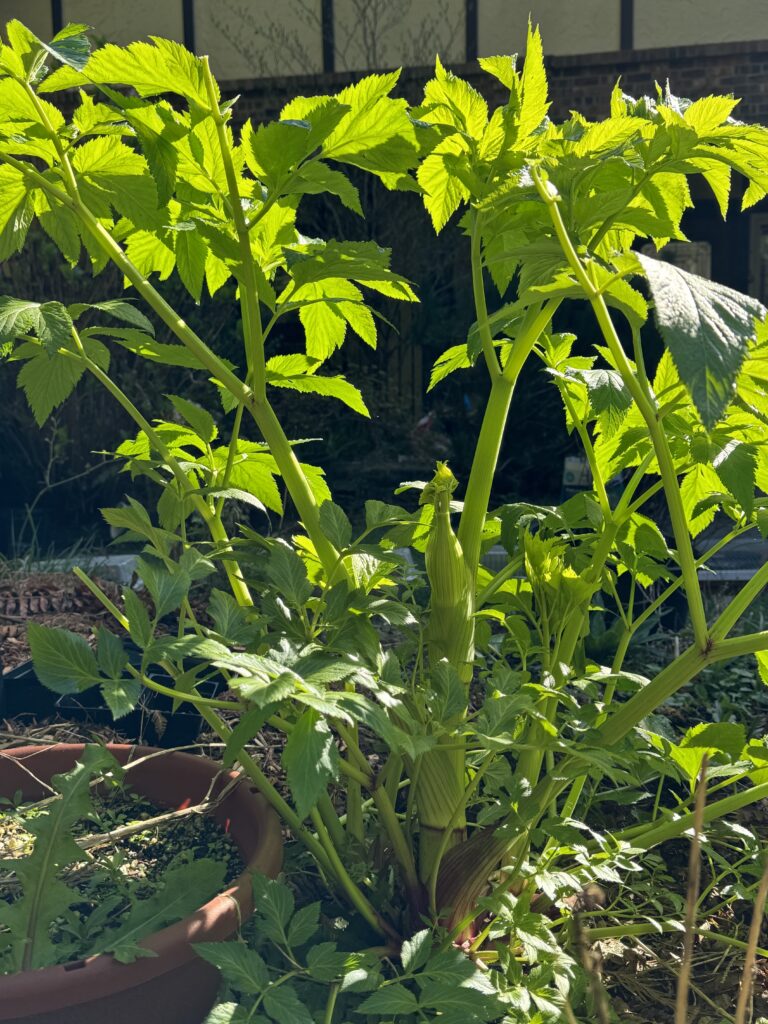
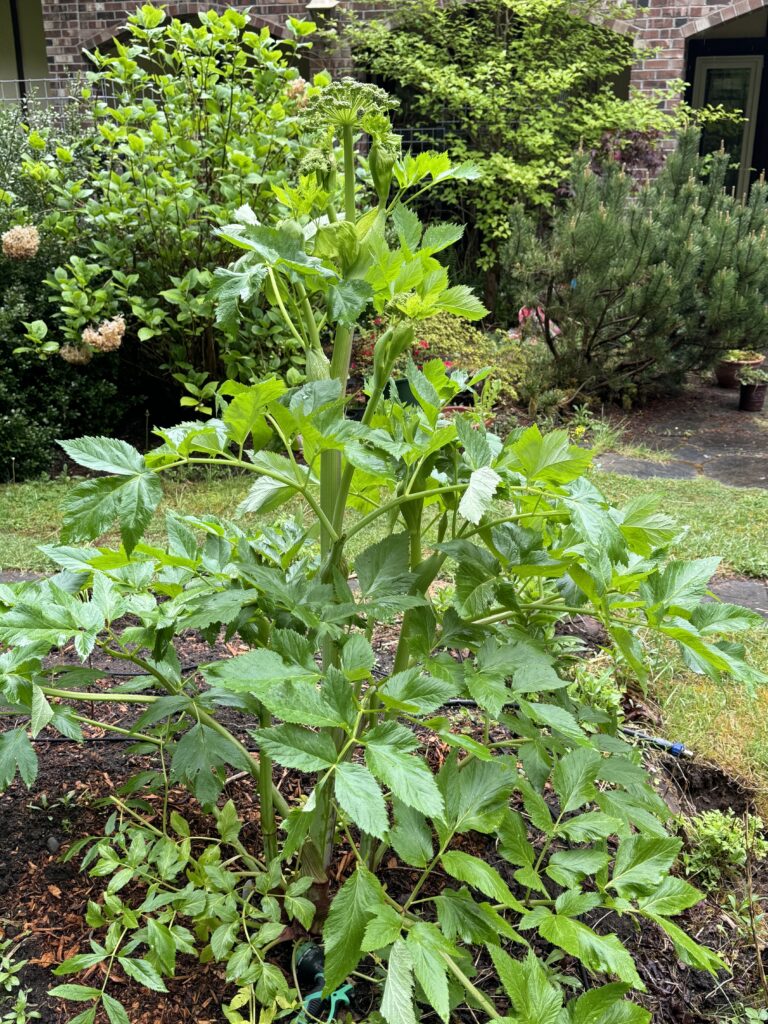
I purchased it as a young plant two years ago, and expected it to bloom last year (it is categorized as a biennial). It turns out to be a “soft” biennial, that might wait an extra year.

I was very excited when the stalk first started going up in late March.

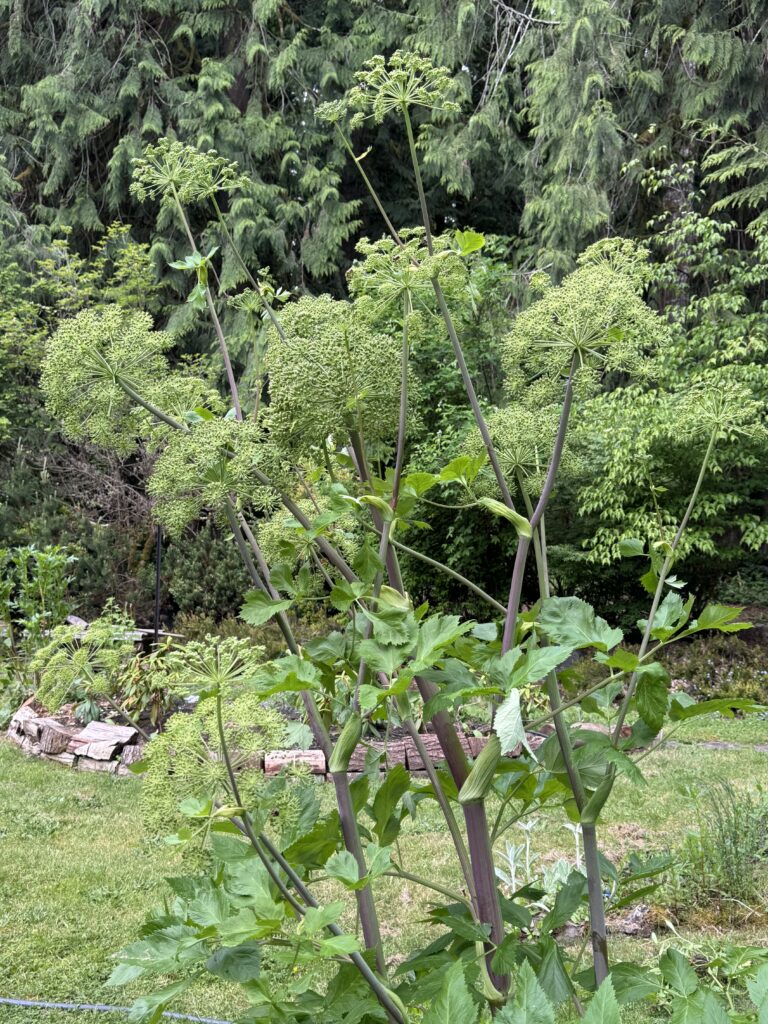
Over the next month, it got taller and taller, until it finally developed the umbel that I was expecting.

I expected it to open into a white-flowered umbel… rather like a giant Queen Anne’s Lace.

Nope!

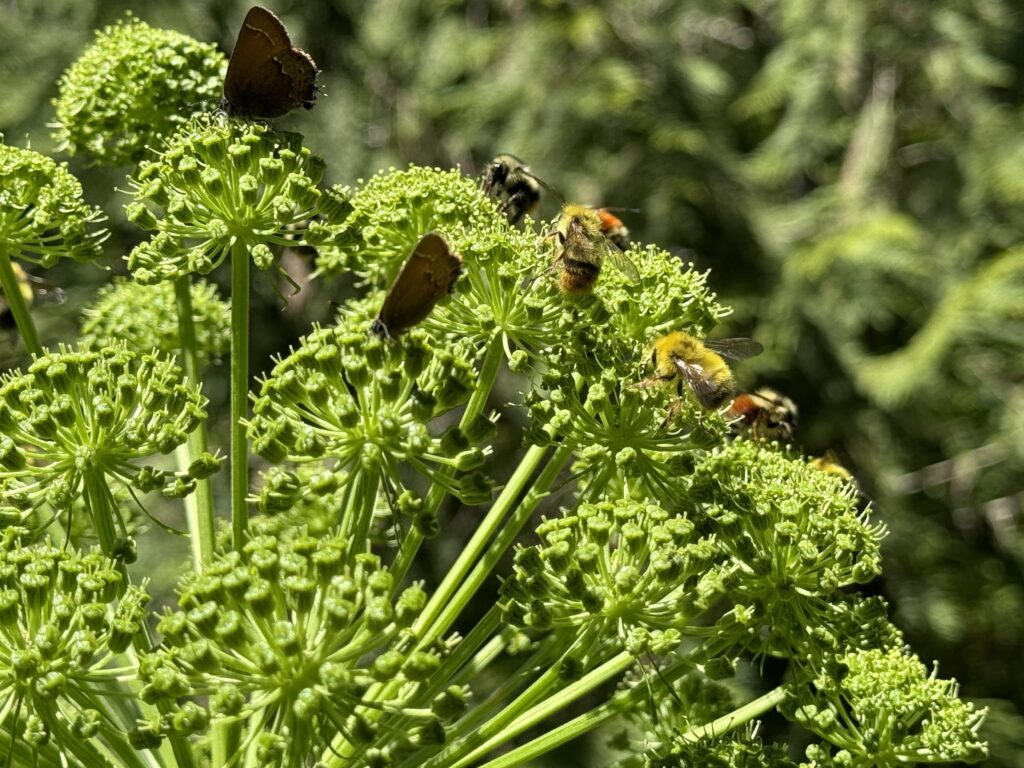
It took another two weeks to open, but I could really only tell because it was covered in foraging pollinators… the flowers stayed green, a little like giant, spherical parsley flowerheads.

The resulting show has been both less pretty, and far more amazing, than I expected.

I expected one big flower. There are dozens!

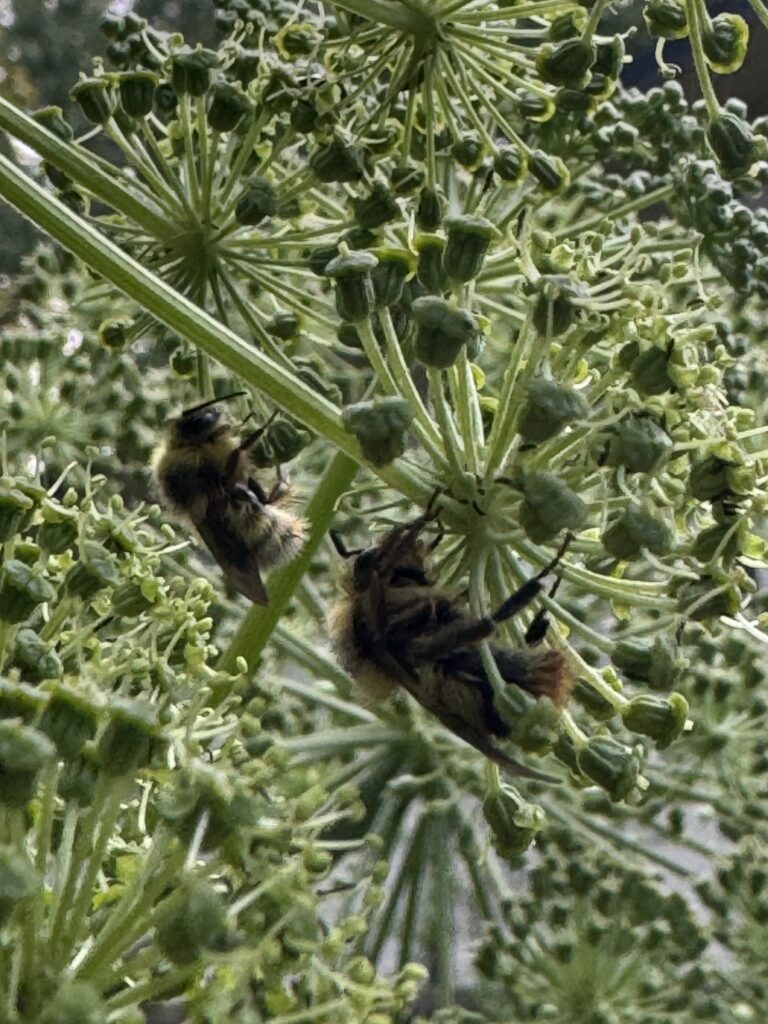
The earliest flower is now developing seeds, but I can tell which heads are in bloom at any time based on the cloud of bumblebees.

Yesterday morning, I went out early, and was surprised to spot a bunch of bumblebees clinging to the bottom edge of the flowers. Napping!

I’m surprised such an open flower makes a good bivouac, but they’re the experts 🙂

All parts of the Angelica are good to eat; it tastes like a potent combination of celery and fennel. I’m guessing the seeds should be good for cooking, and I’ll be sure to plant some for future years.

The Angelica also has one offset on the main plant, so I’m hoping that it might survive the flowering. Otherwise it will be three years before I have this fun again!

Spring Movements

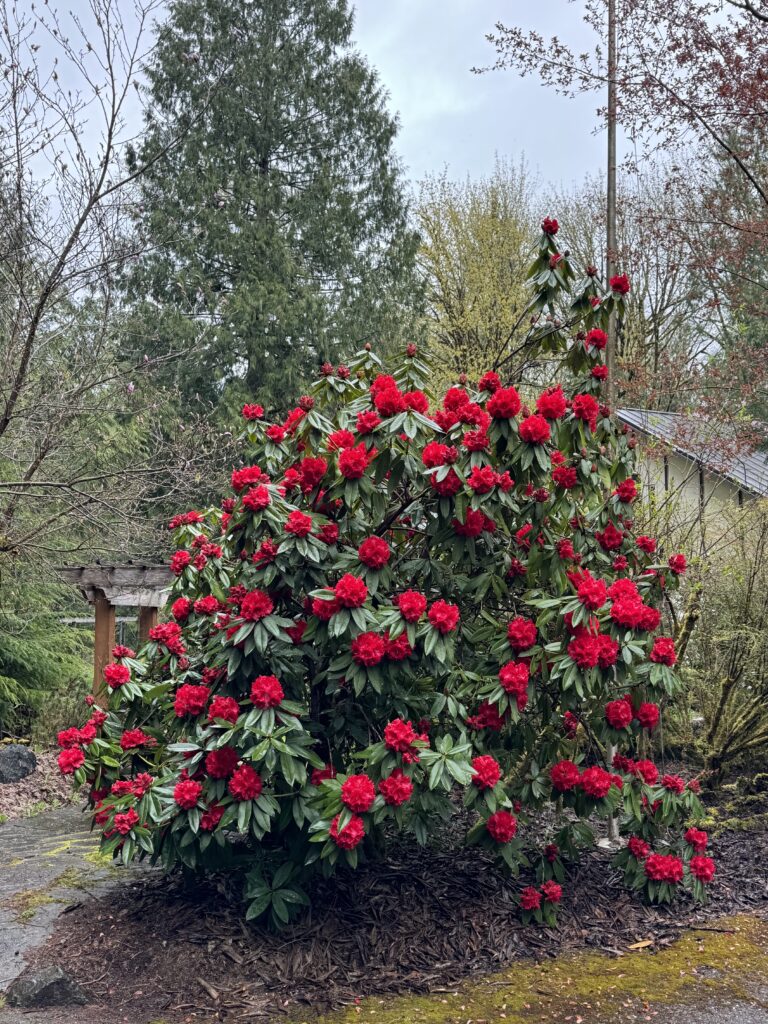
It is feeling like mid-spring here.

The early red rhodie is now in full bloom.

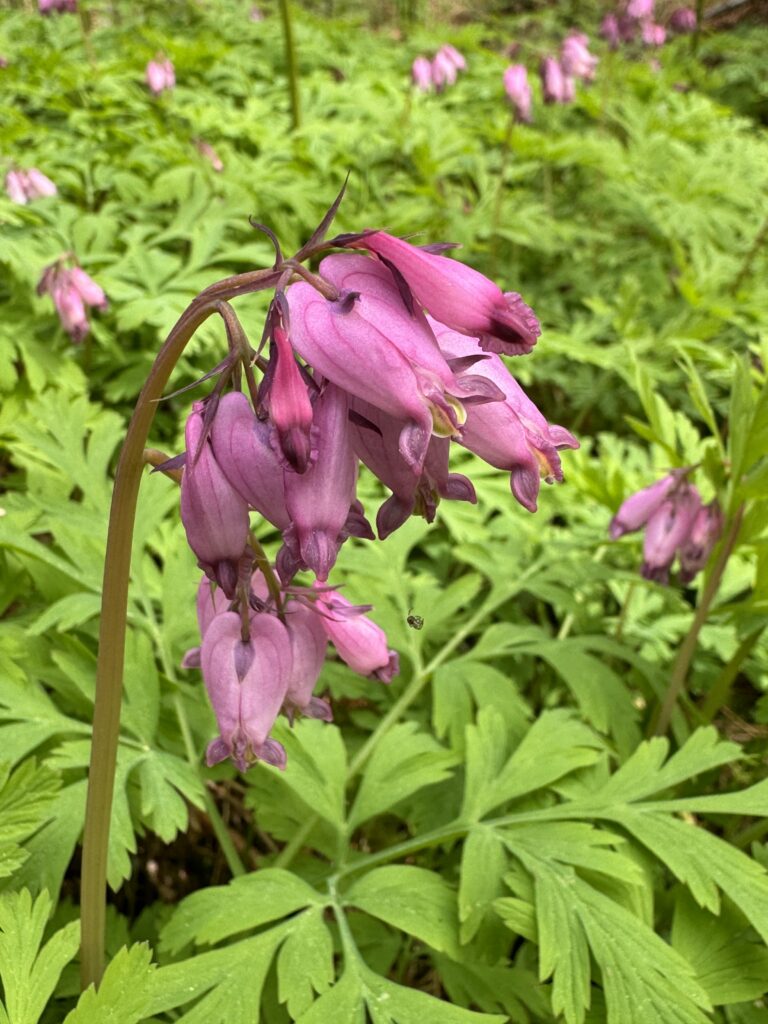
And the native bleeding hearts are getting started.

I saw my first bat yesterday evening, although I haven’t been keeping an eye out, so they may have been here for a while.

I went out to listen to the spring chorus a few times last week. Here’s who’s around (seen or heard):

  • Anna’s Hummingbird
  • Barred Owl
  • Brown Creeper
  • Chickadee, Chestnut-backed
  • Cooper’s Hawk
  • Crow, American
  • Dove, Mourning
  • (Finch, Purple)
  • Junco, Dark-eyed
  • Kinglet, Golden-crowned
  • Kinglet, Ruby-crowned
  • Mallard
  • Nuthatch, Red-breasted
  • Pine Siskin
  • Raven, Common
  • Robin
  • (Sparrow, Chipping)
  • Sparrow, Song
  • Sparrow, White-crowned
  • Stellar’s Jay
  • Towhee, Spotted
  • Varied Thrush
  • Wood Duck
  • Woodpecker, Pileated
  • Wren, Pacific

    I was surprised not to hear any black-capped chickadees. Maybe they migrate, and I just never noticed, since the chestnut-backed are around all year?

    It will be interesting to see who shows up in the next few weeks!

  • More Frost Flowers, iPhone

    We had the correct conditions for frost flowers (hair ice) two days last week: overnight Tuesday (with pictures Wednesday morning) and overnight Wednesday (with pictures Thursday morning).

    This sort of clustering is common, because the clear day/cold snap (for us!) conditions required for frost flowers tend to cluster.

    Olympia, March 7 2024, iPhone 15 pro

    Yesterday I talked a bit about the conditions that allow frost flowers and hair ice to “grow”; today I want to talk a little bit about photographing frost flowers, with a focus on my latest experience with the iPhone 15.

    Olympia, March 7 2024, iPhone 15 pro

    I have been photographing frost flowers for a few years now. I saw my first frost flowers on a cold morning along the Elwha river in 2015. The following winter, I discovered them growing in our home woods in Port Angeles.

    Elwha River frost flower, 2015, photographed with an iPhone 5

    When we moved to Olympia, I was delighted to discover that our local woods “grew” frost flowers even more frequently than our Port Angeles woods. Since moving, I have been photographing frost flowers happily with an iPhone 10, sometimes in combination with a hand lens.

    Olympia Frost Flower, January 2022, photographed with an iPhone 10

    I was able to get some great frost flower pictures with my iPhone 10, and was generally delighted with its macro quality. However, it did tend to lose detail when there was any degree of light; it would all just go to white (as in the top of this picture).

    When I got my iPhone 15 pro a couple weeks ago, I was initially extremely excited about its macro potential. However, a couple experiments with flowers had me concerned. This flush of frost flowers was my first opportunity to try my new camera (phone) with one of my favorite subjects.

    Olympia, March 7 2024, iPhone 15 pro

    Overall, I’m very pleased with the results. The macro setting did not have the same issue it did with flowers. I think the flowers failed because the sensors got confused about what to focus on; with the frost flowers, it was a larger field of focus, so it didn’t get confused.

    Olympia, March 7 2024, iPhone 15 pro

    The macro setting allows me to focus close-in at least as well as the iPhone 10 plus hand lens, which is lovely. They have also done some fancy footwork to take care of the whiteout issue that I often had with the iPhone 10. Each strand really stands out.

    Olympia, March 7 2024, iPhone 15 pro

    Is it hands-down better than the iPhone 10?

    Well… no. I love that it captures all the detail, and makes it easier to see the individual strands. But I think its focus has some issues, and everything winds up looking super crystalline (partly as a result of the lighting fancy-footwork). The pictures lose some of the satiny quality of the frost flowers.

    Olympia, March 7 2024, iPhone 15 pro

    I feel like the best of my iPhone 10 photos were better than my iPhone 15 photos, but the conditions had to be just right. With the iPhone 15, I can easily capture the wonderful detail of the frost flowers, but the feel is a little different. And it can capture frost flowers that would have just been a mass of white in the iPhone 10, such as this candy-floss type.

    Olympia, March 7 2024, iPhone 15 pro

    Anyway, I’m generally pleased, but I really hope Apple fixes the macro focus issues before (botanical) flower season is here in earnest!

    Late Frost Flowers

    We’re lucky enough to live in a region that usually gets frost flowers (hair ice) several times each winter. This winter was weird, though — too warm, and then too cold, and then too warm — so I was starting to wonder whether we would get any really good frost formations.

    We got a few, early, back in November, but we hadn’t had any truly good blooms.

    Finally, on the morning of March 6th, we got a very good bloom! It was clear, and hit around 28F, which is perfect for “growing” frost flowers/hair ice.

    Please note that the general frost flower commentary below is taken from this post from a couple years ago. All the photos are new.

    Frost flowers (hair ice) form when there are sodden sticks that dip below freezing overnight. Around here, the sweet spot is ~28-31 F. It needs to be cold enough to produce frost, but not so cold as to freeze the stick solid.

    The ice forms on the surface of the stick, and is extruded as it freezes to form “hair” which can take beautiful forms that look like silvery locks or silvery flowers.

    There is a fungal association with Exidiopsis effusa. Around here, there is also a clear preference for alder twigs and branches. I’m not sure whether that’s what the fungus prefers, or whether the wood somehow favors frost flower formation.

    Frost flower and hair ice are two terms used semi-interchangeably. As far as I can tell, the distinction is mostly based on the type of formation. If it’s a burst formation (e.g. from the end of a stick), it’s a frost flower. If it looks like hair growing out of the middle of a stick, it’s hair ice. Even though most of what we get is probably more hair ice than frost flowers, I like the latter term better 🙂

    Frost flowers and hair ice are relatively rare worldwide. They require specific conditions to “grow”. In climates with cold winters, you might be lucky enough to see a few in the autumns. 

    Here in the Puget Sound area, the winters are mild and tend to only dip below freezing occasionally. We also have an abundance of alders. That gives us the ideal conditions for hair ice and frost flowers.

    To see them, go out on a cold morning and check any local alder groves. They tend to be more common at the edges of alder groves, where the sticks are a bit more exposed… but that depends on the temperature range. On a very cold morning (25-28F) there may be such formations deeper in the woods.

    They are most common on mid-sized twigs and branches (~1/2-2″ diameter), but occasionally they grow on larger or smaller branches.